
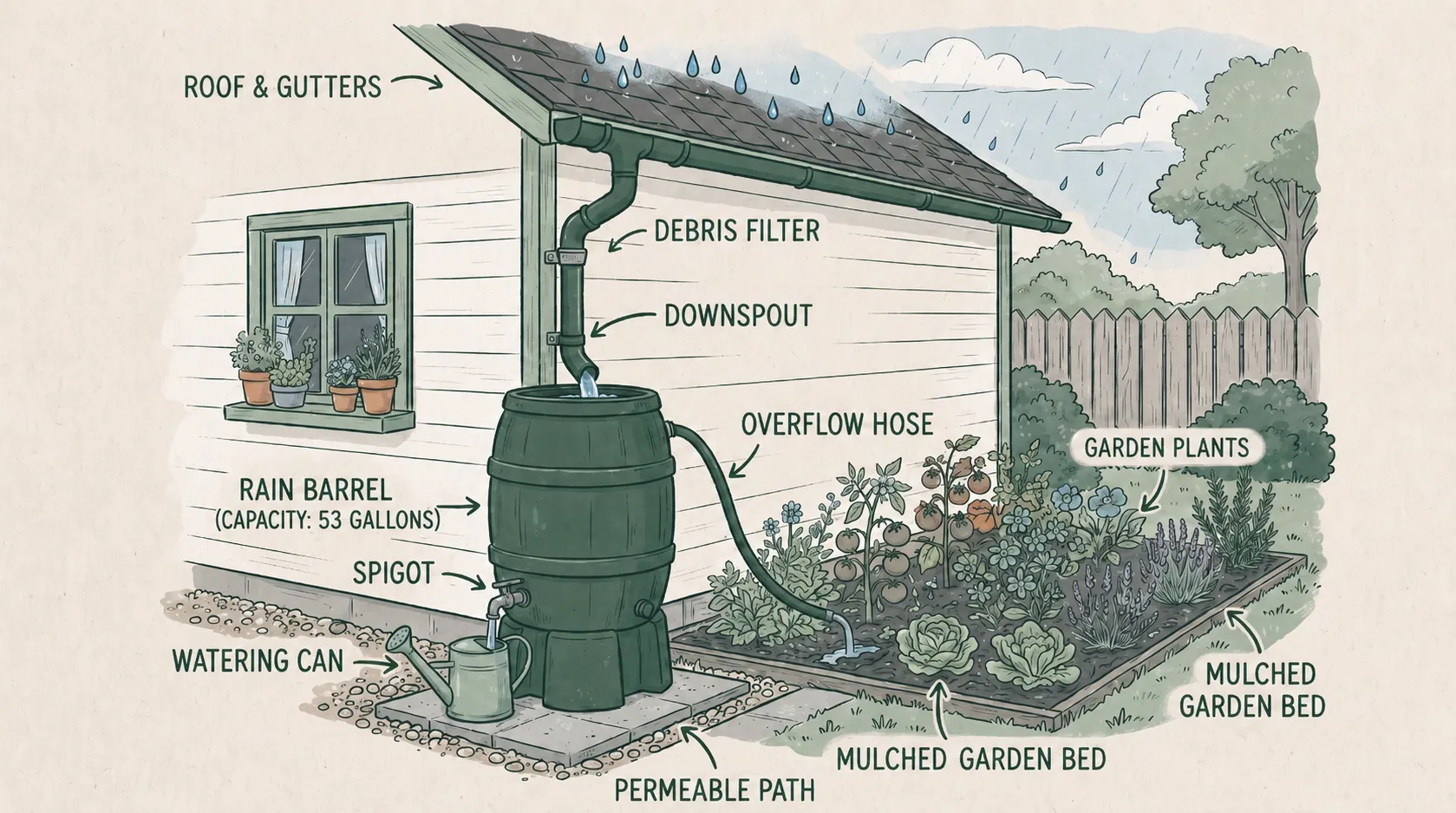
A surprisingly small amount of rain can fill a household rain barrel. If 1,000 square feet of roof drains toward one downspout, roughly one tenth of an inch of rain may be enough to fill a 55-gallon barrel.
That makes rainwater harvesting sound simple, and at the smallest scale, it can be. Connect a covered barrel to a downspout, keep debris and mosquitoes out, and use the stored water for suitable outdoor tasks.
The part beginners often underestimate is what happens after the barrel fills. A safe system needs a stable base, an adequately sized overflow route, appropriate screening, and a realistic plan for using the water between storms.
This guide explains how to plan a basic home rainwater system, estimate how much the roof can collect, choose between a barrel and a larger cistern, and avoid the mistakes that commonly turn a useful project into a drainage or maintenance problem.
Location note: This guide uses US customary measurements and primarily US-based technical references. Rainwater laws, approved uses, plumbing requirements, and public-health guidance vary by location, so readers should verify current requirements with their local building, health, environmental, or water authorities.
A sensible first system
For most beginners, a practical starting point is one covered 50- to 55-gallon barrel connected to a suitable downspout. It should have a fine inlet screen, a secure lid, a low spigot, a stable raised base, and an overflow outlet and hose large enough to carry excess water away safely.
Use the collected water for low-risk non-potable purposes, such as ornamental plants. Test the overflow with a garden hose before the first storm, and expand the system only after learning how quickly the barrel fills and how consistently the water is used.
What Is Rainwater Harvesting?
Rainwater harvesting is the process of collecting, directing, storing, and using rainfall that lands on a roof or another suitable surface.
In a typical residential system, rain follows this path:
- Rain lands on the roof.
- Gutters collect the roof runoff.
- A downspout directs it toward the storage system.
- Screens or filters remove larger debris.
- The water enters a rain barrel or cistern.
- An outlet, hose, or pump delivers the stored water when needed.
- An overflow route carries excess water safely away when the container is full.
A small rain barrel is commonly used for watering ornamental plants and completing low-risk outdoor cleaning tasks. Larger cistern systems may supply landscape irrigation, toilet flushing, laundry, or other approved non-potable uses. Systems connected to indoor plumbing generally require additional filtration, backflow protection, permits, safe separation from drinking-water pipes, and professional design.
Why Collect Rainwater at Home?
The usefulness of a rainwater harvesting system depends on local rainfall, roof size, available storage, water demand, and how consistently the stored water is used.
It can reduce the use of treated water
Treated municipal water is suitable for drinking, cooking, and sanitation, but households also use it for tasks that may not require drinking-water quality.
Collected rainwater may replace some tap water used for:
- Ornamental plants
- Trees and shrubs
- Lawns
- Indoor non-edible plants
- Washing garden tools
- Certain outdoor cleaning tasks
This does not necessarily produce a dramatic reduction in a household’s total bill, especially when water is inexpensive or rainfall is limited. However, the system can reduce some demand for treated water when it is sized and used effectively.
It can reduce roof runoff
A rain barrel temporarily holds water that would otherwise flow immediately from a downspout.
This can reduce runoff during smaller storms, particularly when the barrel has available capacity before rain begins. Capturing roof water may also help reduce erosion, puddling, and the quantity of water entering streets or storm drains.
A barrel that remains full throughout the rainy season provides little additional stormwater storage. Using the water between storms creates space for the next rainfall event.
It can provide a reserve during dry periods
Stored rainwater can be useful when rainfall becomes less frequent, watering restrictions apply, or plants need supplemental irrigation.
A small barrel is not a complete drought solution. A 50-gallon container can be emptied quickly when watering a large lawn or garden. Nevertheless, it can provide a useful reserve for selected plants and small landscaped areas.
It can help manage drainage problems
A properly designed system allows the homeowner to control where the captured water and overflow travel.
Instead of releasing water directly beside the foundation, the overflow may be directed toward an appropriate landscaped area, rain garden, or existing drainage route.
The overflow must never be allowed to create flooding, erosion, slippery walkways, or moisture problems near the building.
Safety note: Rainwater quality, permitted uses, and installation requirements vary. Read the Dimaverde DIY and Safety Disclaimer before beginning a project.
How Much Rainwater Can a Roof Collect?
Even a relatively small roof can produce more runoff than many beginners expect.
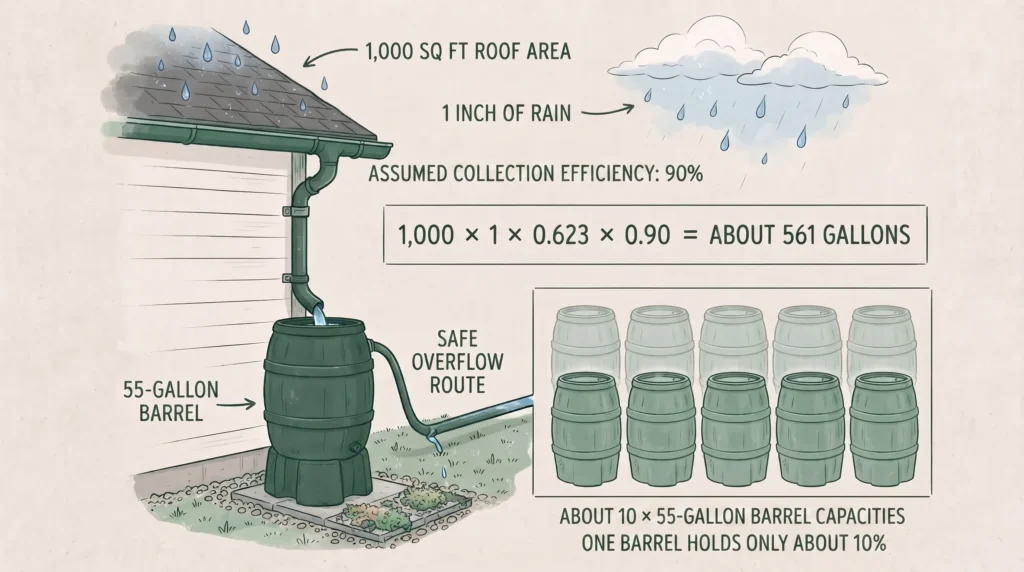
One inch of rainfall over one square foot equals approximately 0.623 gallons of water. A practical collection estimate can therefore be calculated with this formula:
Roof collection area × rainfall in inches × 0.623 × efficiency factor
An efficiency factor of about 0.90 provides a reasonable allowance for water lost through splash, minor gutter overflow, roof wetting, and, in systems that use one, a first-flush diverter. The University of Arizona Cooperative Extension uses this approach when estimating residential collection potential.
Example calculation
Suppose that 1,000 square feet of roof drains toward the downspout connected to the system, and a storm produces one inch of rain:
1,000 × 1 × 0.623 × 0.90 = approximately 561 gallons
That amount of runoff is enough to fill a 55-gallon barrel about ten times. Unless additional barrels or a larger tank are connected, most of the water would leave through the overflow after the first barrel filled.
This illustrates an important point: roof collection capacity and storage capacity are not the same thing.
A roof may produce hundreds of gallons during one storm, while a single barrel stores only a fraction of that amount. Any additional water must pass through a safe overflow system.
Estimated collection at 90% efficiency
| Roof area draining to the barrel | 0.25 inch of rain | 0.5 inch of rain | 1 inch of rain |
|---|---|---|---|
| 500 sq. ft. | About 70 gallons | About 140 gallons | About 280 gallons |
| 1,000 sq. ft. | About 140 gallons | About 280 gallons | About 561 gallons |
| 1,500 sq. ft. | About 210 gallons | About 421 gallons | About 841 gallons |
These estimates show why overflow design matters. Even a quarter-inch storm can produce more water than a standard barrel can hold.
Example: Is one barrel enough?
For instance, a homeowner has approximately 800 square feet of roof draining toward one downspout. A quarter-inch rainfall could produce roughly 112 gallons after allowing for normal collection losses.
One 55-gallon barrel would fill, and nearly half the available runoff would continue through the overflow. Two connected barrels could capture most of that particular storm, but only if the household has a realistic use for approximately 110 gallons before the next rainfall.
The lesson is not that every home needs two barrels. It is that storage should be chosen by comparing roof supply with actual water demand.
Measuring the correct roof area
Measure only the portion of the roof that drains to the selected downspout.
Use the roof’s approximate horizontal footprint rather than trying to measure the sloped surface itself. For a simple rectangular section, multiply its horizontal length by its width. If several sections feed the same gutter and downspout, include the horizontal footprint of each relevant section.
The calculation does not need to be perfectly precise for an initial barrel project. Its purpose is to show whether a small container will be sufficient and how quickly it may fill.
For more advanced system planning, use local monthly rainfall data rather than relying only on annual rainfall. Rainfall concentrated into a short wet season requires different storage from the same annual total spread throughout the year. The US Department of Energy provides a calculator that estimates monthly collection from roof size and rainfall data.
Nine Components Every Basic System Needs
A reliable system includes more than a container and downspout.
1. Roof catchment surface
The roof is the primary collection surface.
Its condition and material can affect water quality. Rainwater may pick up:
- Dust
- Leaves
- Pollen
- Bird and animal waste
- Roofing particles
- Metals
- Chemical residues
- Airborne pollution
Inspect the roof and gutters before choosing how the water will be used. Water from roofs containing questionable coatings or materials should not be assumed suitable for sensitive uses.
2. Gutters and downspouts
Gutters carry water from the roof toward the storage container.
They should be:
- Securely attached
- Correctly sloped
- Free of major leaks
- Large enough for local rainfall intensity
- Regularly cleared of leaves and debris
A blocked gutter can cause water to overflow beside walls, doors, walkways, or foundations.
3. Leaf screen or debris filter
Screens prevent leaves, twigs, seeds, insects, and larger debris from entering the storage container.
Possible screening locations include:
- The gutter
- The top of the downspout
- The barrel inlet
- A separate pre-filter
Screens need regular inspection. A clogged screen can prevent water from entering the barrel or cause the gutter to overflow.
4. First-flush diverter
The first runoff from a roof often contains the highest concentration of dust, animal waste, and other accumulated material.
A first-flush diverter sends the initial portion of water away from the storage tank before allowing cleaner runoff to enter it. The CDC recommends considering a first-flush device as one way to improve collected-water quality.
A first-flush diverter does not make rainwater safe to drink. It is one component of contamination control, not a complete treatment system.
5. Storage container
The storage container may be a rain barrel, above-ground cistern, or underground tank.
A suitable container should be:
- Structurally sound
- Designed to hold water
- Opaque or protected from sunlight
- Securely covered
- Resistant to expected outdoor conditions
- Accessible for inspection and cleaning
- Made from materials appropriate for the intended use
Sunlight entering the container encourages algae growth. Opaque containers help limit this problem.
Do not reuse a barrel that previously held fuel, pesticides, industrial chemicals, or another unknown substance.
6. Mosquito protection
Every opening should be covered with fine, secure screening.
Mosquitoes can breed in standing water when they are able to enter the container. The CDC advises using screening or emptying a rain barrel at least every 10 days as mosquito-control measures.
A properly sealed system should not leave open pools of water around its base, overflow hose, or nearby ground.
7. Overflow outlet
A barrel will eventually fill. The overflow system determines what happens next.
Overflow water should be directed:
- Away from the building foundation
- Away from neighbouring property
- Away from septic systems and wells
- Away from walkways and other slip hazards
- Toward an appropriate drainage or infiltration area
The overflow outlet should be at least as capable of carrying water as the inlet system. A small overflow opening can become overwhelmed during heavy rainfall.
8. Spigot or outlet
A low outlet allows the stored water to be removed using a watering can or hose.
Raising the barrel can provide space beneath the spigot and modest gravity flow. However, the supporting base must be level, stable, weather-resistant, and strong enough to carry the weight of a full container.
Water weighs about 8.3 pounds per gallon. The water inside a full 55-gallon barrel therefore weighs approximately 460 pounds, or about 209 kilograms, before adding the weight of the barrel and fittings.
9. Pump, when necessary
Gravity may be sufficient for filling a watering can or slowly feeding a nearby hose.
A pump may be needed for:
- Longer hose runs
- Drip irrigation
- Higher elevations
- Consistent pressure
- Larger cistern systems
The pump must be suitable for the system, protected from running dry, and installed according to its instructions.
Rain Barrel or Cistern: Which Is Better?
The right storage type depends on the amount of water available and how it will be used.
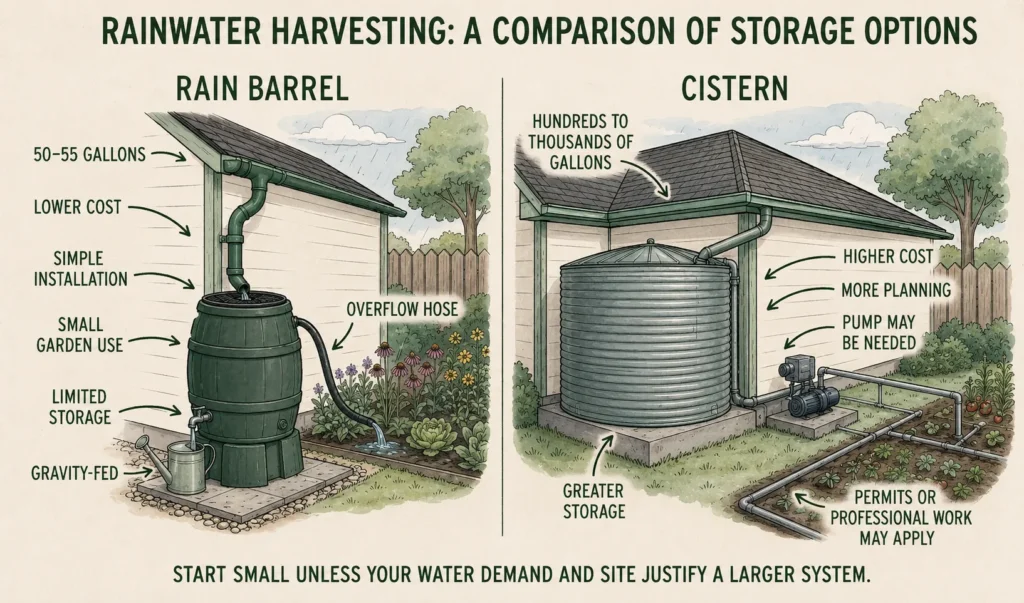
Choose a rain barrel when:
- This is your first collection system
- Available space is limited
- The intended use is a small garden
- The budget is modest
- Simple maintenance is preferred
- You may want to relocate or store the barrel when it is empty
Many residential rain barrels hold approximately 50 to 55 gallons, although smaller and larger models are available.
A single barrel is easy to install, but it may fill during a relatively small storm. Multiple barrels can sometimes be connected to increase storage.
Ready to build a basic system? Follow our step-by-step guide on how to install a rain barrel.
Consider a cistern when:
- The roof produces large amounts of runoff
- Water demand is substantial
- Rainfall is seasonal
- Several landscaped areas require irrigation
- A pump will be used
- The system may supply approved indoor non-potable uses
- There is sufficient room and budget
Cisterns may hold hundreds or thousands of gallons and can be installed above ground or underground. They require more careful planning for structural support, access, filtration, overflow, pumping, maintenance, permits, and safe plumbing separation.
What Can Collected Rainwater Be Used For?
The appropriate use depends on the collection surface, water quality, treatment, local rules, and the level of human exposure.
For an untreated residential roof system, the safest uses are generally those with a low risk of swallowing the water.
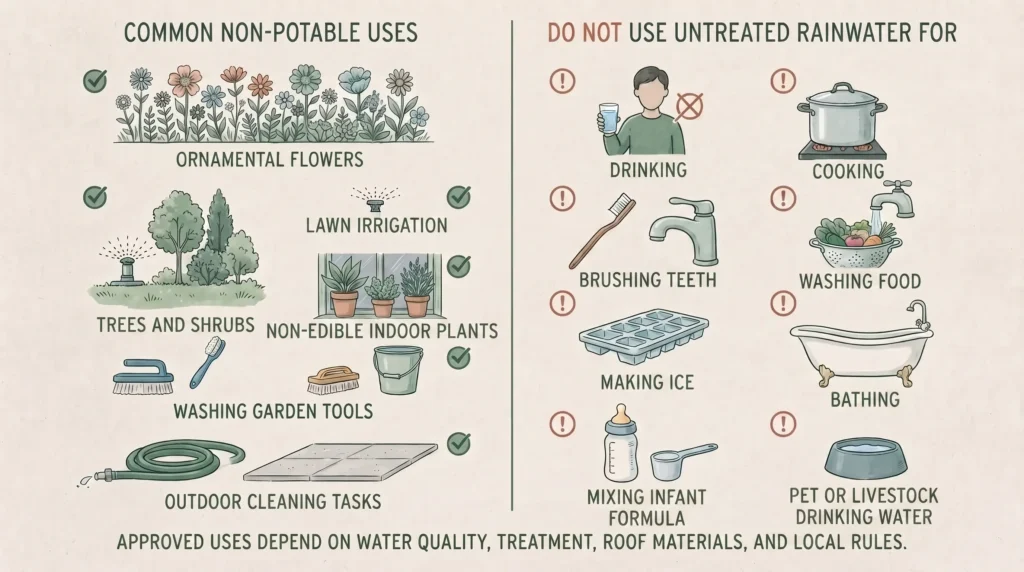
Common non-potable uses include:
- Watering ornamental flowers
- Watering shrubs and trees
- Irrigating lawns
- Watering non-edible indoor plants
- Washing garden tools
- Certain outdoor cleaning tasks
EPA guidance notes that rain barrels commonly provide water for lawns, gardens, and indoor plants. It also warns that roof runoff can contain bacteria from animals and chemicals from roofing materials.
Using rainwater on edible plants
Untreated roof runoff may contain fecal organisms, metals, roofing chemicals, and other contaminants.
Because untreated roof runoff may contain animal waste, metals, roofing residues, and other contaminants, follow local public-health or agricultural guidance before using it on edible crops. When no specific local guidance is available, the cautious approach is to use treated water and avoid applying untreated roof runoff directly to vegetables, herbs, fruit, or other edible plant parts.
Local agricultural or health authorities may provide more specific guidance for your area.
Can You Drink Harvested Rainwater?
Rainwater should not be assumed safe to drink merely because it looks clear.
Before reaching the storage tank, rain may collect germs and chemicals from the air, roof, gutters, pipes, animals, and storage materials. Appearance, smell, and taste cannot reliably confirm that water is safe.
Do not use untreated rain-barrel water for:
- Drinking
- Cooking
- Brushing teeth
- Washing food
- Making ice
- Bathing
- Filling a swimming pool intended for human use
- Mixing infant formula
- Providing drinking water to pets or livestock without appropriate treatment and reliable local or veterinary guidance
A potable rainwater system requires purpose-designed collection materials, filtration, disinfection, regular testing, maintenance, and compliance with applicable health and building requirements.
A simple sediment filter or first-flush diverter is not enough to make contaminated water potable.
Where both rainwater and municipal water are present, they must remain properly separated. Rainwater must not be allowed to flow backward into drinking-water plumbing.
Check Local Rainwater Collection Rules
Rainwater harvesting is not governed by one universal set of rules.
Requirements may vary according to:
- State, province, or region
- County, district, or municipality
- Other local jurisdiction
- Intended water use
- Storage volume
- Above-ground or underground installation
- Connection to indoor plumbing
- Property type
- Homeowners’ association rules
- Local drought or mosquito-control requirements
The US Department of Energy notes that rainwater harvesting is regulated at the state level rather than by one federal collection rule, and that systems may also require local or state permits. Its Rainwater Harvesting Tool provides a state-by-state overview, but current local authorities remain the final source for project requirements.
Before purchasing equipment, check with the relevant:
- Building department
- Health department
- Water utility
- Environmental agency
- Homeowners’ association
- Landlord or property manager
Rules are especially important when the system connects to indoor plumbing or is intended to provide potable water.
How to Plan a Basic Rain Barrel System
A simple outdoor system can be planned in the following order.
Step 1: Decide how the water will be used
Estimate the amount of water needed for the intended plants or outdoor tasks.
A clear purpose helps determine whether a 50-gallon barrel will be useful or whether a larger system is justified.
Step 2: Choose the downspout
Select a downspout near the intended use area.
Check that it:
- Receives a useful amount of roof runoff
- Is accessible
- Has room for the container
- Allows safe overflow routing
- Is not beside electrical equipment
- Is not in a busy walkway
Step 3: Estimate roof runoff
Calculate the approximate roof area draining to the downspout and use the collection formula.
This will show how quickly the barrel may fill and how much overflow the location must handle.
Step 4: Inspect the site
The ground must be firm and level.
Consider:
- Foundation clearance
- Soil stability
- Access for cleaning
- Hose placement
- Children and pets
- Winter conditions
- Overflow direction
- Available sunlight and shade
Step 5: Choose the barrel and fittings
Look for a system with:
- Secure lid
- Fine inlet screen
- Functional overflow fitting
- Accessible spigot
- Opaque construction
- Durable seals
- Connection suitable for the downspout
- Clear installation instructions
Step 6: Build a stable base
Use a purpose-built or carefully constructed platform capable of supporting the full container.
The barrel should not wobble, lean, or settle unevenly after rainfall.
Step 7: Install and test the overflow
Direct overflow away from the house and test it using a hose before relying on it during a storm.
Check for leaks, loose fittings, erosion, or water collecting near the foundation.
Step 8: Label the system
A label stating “Non-Potable Water—Do Not Drink” helps prevent accidental use.
This is particularly important where children, guests, contractors, or tenants may encounter the system.
How Much Does a Home Rainwater System Cost?
A basic ready-made rain-barrel system may cost anywhere from a modest amount for a subsidized municipal barrel to considerably more for a decorative or higher-capacity model. The total cost depends on whether the barrel includes a diverter, screened inlet, overflow fittings, spigot, connecting hose, and supporting base.
Before paying full retail price, check whether the local water utility, municipality, conservation district, or stormwater program offers discounted barrels or rebates.
Larger cistern systems cost substantially more because they may require a reinforced base, excavation, pumps, filters, electrical work, plumbing modifications, permits, and professional installation. Obtain current local quotations rather than relying on a national estimate.
A Simple Maintenance Routine
A rainwater harvesting system requires regular attention.
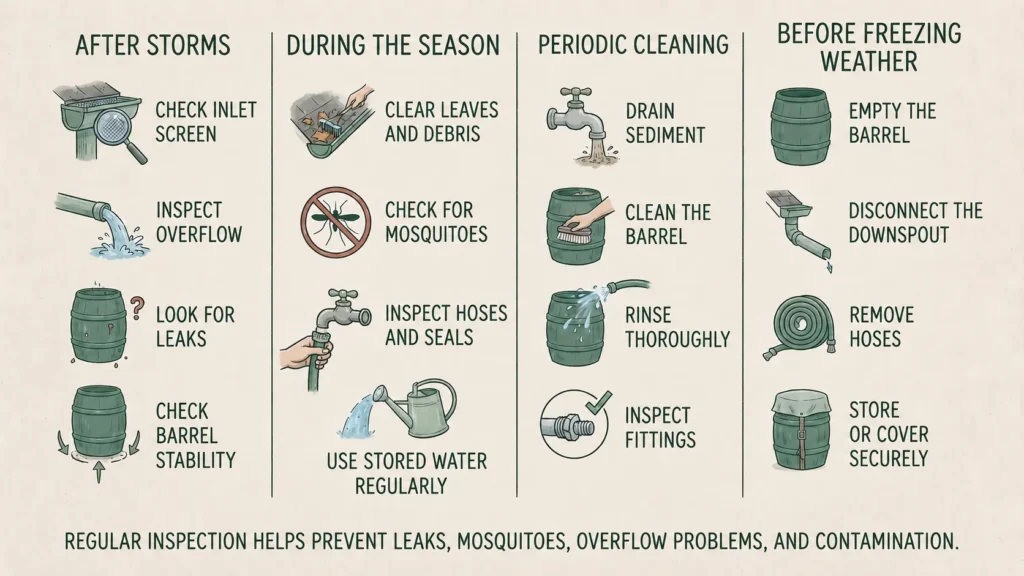
After storms
Check:
- Inlet screens
- Overflow flow
- Leaks
- Barrel stability
- Standing water around the base
- Erosion near the overflow outlet
During the collection season
Regularly:
- Remove leaves and debris from gutters
- Clean screens and filters
- Inspect seals and hoses
- Check for mosquitoes
- Confirm that the lid remains secure
- Use stored water to create space before future storms
- Examine the water for unusual odor, color, or contamination
Unusual appearance does not identify every safety problem, but it may indicate that the system needs cleaning or that the water should be discarded.
Periodic cleaning
Drain the container and remove accumulated leaves, sediment, and residue.
Clean the interior with water and a mild detergent when permitted by the manufacturer, then rinse it thoroughly so that detergent residue does not remain in the barrel. Inspect the inlet screen, outlet, overflow fitting, and seals before reconnecting the system.
Follow the manufacturer’s cleaning instructions and dispose of contaminated water where it will not enter wells, waterways, edible gardens, or neighbouring property.
Winter preparation
In freezing climates:
- Empty the barrel
- Disconnect it from the downspout
- Remove hoses and detachable fittings
- Store it upside down or securely covered
- Restore the normal downspout route
- Prevent water from freezing inside the container
Frozen water expands and can crack the barrel, fittings, or connected pipes.
Common Rainwater Harvesting Mistakes
Installing a barrel without adequate overflow
Every barrel eventually fills. Uncontrolled overflow can damage foundations, flood walkways, erode soil, or affect neighbouring property.
Using an open container
An open barrel allows insects, animals, leaves, and debris to enter. It may also present a hazard to children and pets.
Placing the barrel on an unstable base
A full barrel is extremely heavy. Loose blocks, soft ground, and makeshift furniture may shift or collapse.
Assuming clear water is safe to drink
Microorganisms and chemicals are not always visible. Untreated roof water is not automatically potable.
Ignoring the previous use of a recycled barrel
A container that once held hazardous or unknown substances should not be converted into a rain barrel.
Allowing collected water to enter drinking-water pipes
Cross-connections can contaminate the household water system. Indoor integration should be designed in accordance with plumbing codes and appropriate backflow protection.
Forgetting to use the stored water
A permanently full barrel cannot capture the next storm. Regular use is part of both water conservation and runoff management.
Buying storage without estimating supply or demand
An undersized barrel may overflow constantly, while an oversized and expensive tank may remain mostly empty in a dry climate.
Before You Buy: A Quick Fit Check
A rain barrel is likely to be useful when:
- A suitable downspout is close to the area where the water will be used
- The site has firm, level ground and a safe overflow route
- Ornamental plants or other appropriate outdoor uses need regular water
- The barrel can be emptied often enough to create room for the next storm
- Someone is willing to inspect the screens, fittings, and overflow regularly
A basic barrel may provide limited value when:
- Rainfall is extremely infrequent
- The stored water has no practical use
- The only available location is unstable or too close to the foundation
- Overflow cannot be directed safely
- A pressurized irrigation system is required but no suitable pump is planned
- Local rules prohibit or significantly restrict the intended installation
The best system is not necessarily the one with the greatest capacity. It is the one that matches the roof supply, available space, intended use, and realistic maintenance routine.
Frequently Asked Questions
Can two rain barrels be connected?
Yes. Compatible barrels can often be linked so that water flows into additional storage after the first barrel fills. All connected barrels still need stable support, secure screening, and sufficient final overflow capacity.
Can rainwater be stored indefinitely?
Long storage can lead to sediment, odors, algae, insects, or microbial growth when the system is not properly sealed and maintained. Use and rotate the water regularly rather than treating a basic barrel as permanent storage.
Can a rain barrel be connected to drip irrigation?
It can, but gravity pressure may be too low for some drip components. A low-pressure system or suitable pump may be required. Check the pressure and filtration requirements of the irrigation equipment.
A Practical Starting Point
Begin with a specific use for the water, not with the largest tank that will fit beside the house.
For many households, one secure 50- to 55-gallon barrel is enough to learn how quickly the selected roof section produces runoff, how often the stored water is used, and whether additional capacity would be worthwhile.
Before the first storm, confirm that the barrel is stable, every opening is screened, and the overflow carries water away from the building without causing erosion or affecting neighbouring property. Use the water regularly, inspect the system after storms, and expand only when actual supply and demand justify it.
A small, well-maintained system with a safe overflow route is more valuable than a large installation that remains full, develops contamination problems, or creates drainage risks.
How This Guide Was Prepared
This guide draws on public-health guidance, government water-conservation resources, university-extension publications, and residential rainwater-harvesting references.
Dimaverde did not physically test a specific rain barrel or cistern for this article. Statements about system design, maintenance, and water quality are based on the cited research rather than claimed personal experience.
Product specifications, public-health recommendations, incentives, and local regulations can change. Verify important requirements before purchasing or installing a system.
Sources and Further Reading
The following government and university-extension resources provide additional guidance on rainwater collection, health considerations, system sizing, maintenance, and local regulations.
- U.S. Environmental Protection Agency — Soak Up the Rain: Rain Barrels
A practical overview of rain-barrel benefits, common landscape uses, stormwater reduction, and potential contamination from roofs and animals. - Centers for Disease Control and Prevention — Collecting Rainwater and Your Health
Guidance on rainwater contamination, lower-risk uses, first-flush diverters, mosquito prevention, testing, treatment, and keeping rainwater separate from drinking-water plumbing. - U.S. Department of Energy — Rainwater Harvesting Tool
An interactive resource covering rainwater-harvesting potential, landscape-irrigation potential, and state-level regulations across the United States. - U.S. Department of Energy — Rainwater Harvesting Calculator
A downloadable tool for estimating the amount of rainwater that a roof or other hard surface may collect each month using location, rainfall, and catchment-area data. - University of Arizona Cooperative Extension — Harvesting Rain in Cochise County
Explains the standard roof-collection calculation, the use of a collection-efficiency allowance, and practical considerations such as mosquito screening and opaque storage containers. - University of Minnesota Extension — Rain Barrels in the Home Landscape
Research-based guidance on suitable uses, barrel installation, overflow management, cleaning, maintenance, and winter storage. - Pacific Northwest National Laboratory — Rainwater Harvesting State Regulations and Technical Resources
A detailed PDF report prepared for the U.S. Department of Energy that explains the regulatory research behind the federal rainwater-harvesting map and provides state-by-state technical resources. The report was published in June 2019, so its individual legal summaries should be treated as background information rather than a substitute for checking current state and local requirements.
1 thought on “Rainwater Harvesting at Home: A Beginner’s Guide”